

Corporate Graduation

You've spent 20 years building something you don't own.
You're a Director, a VP, maybe higher. You're very good at what you do. People lean on your judgment. The comp is strong.
From the outside, it looks like the life you were supposed to want.
And there's something you want that you've been telling yourself you can't have.
Maybe it's a thing of your own. Maybe it's your evenings back. Maybe it's building something that doesn't disappear into somebody else's quarterly numbers.
You don't say it at dinner, because your life is complicated. A mortgage, maybe two. Kids, tuition, a spouse counting on the plan. Aging parents. People depending on you not to do anything reckless.
So you keep going. Another quarter. Another year.
Why This Exists
I know that place, because I lived there.
15 years in strategy consulting, at firms like BCG and Booz Allen. Good title, good money. And it was quietly eating me alive.
Calling my life complex would be an understatement. 4 kids. A divorce and child support. 2 mortgages. Remarried. Blended family. Global travel for work.
I couldn't blow it up, and I couldn't stay.
The first thing I had to do was save myself.
It took 3 businesses that failed before one worked, and $250,000 of self-investment in coaches, masterminds, and programs since then. Every failure and every dollar compounded into the same thing: a system.
Compress the corporate job. Keep the paycheck.
Restore my health and my home life.
Build a unique, scalable business on top.
I built it to get myself out first.
But the need turned out to be much bigger.
I've since worked with hundreds of people making the same move.
Corporate Graduation, Defined.
I call that system Corporate Graduation®.
Simply put: Corporate to Founder in 1 year.
Without torching your income, your family, or your reputation.
It's the move from your Corporate Past to your Founder Future.
Your Corporate Past deserves gratitude. It gave you the skills, the judgment, the income, and the relationships you're sitting on right now. I was grateful for mine. I was also being called to something different.
"Founder" may not be the word you'd pick for yourself yet. By the end of this, I think you'll see why it's the only one that fits.
If you'd rather watch, the full video is right here:
Who It's For
It's for Directors, VPs, and Executives with complicated lives and a lot of career capital. It usually finds them in one of three places.
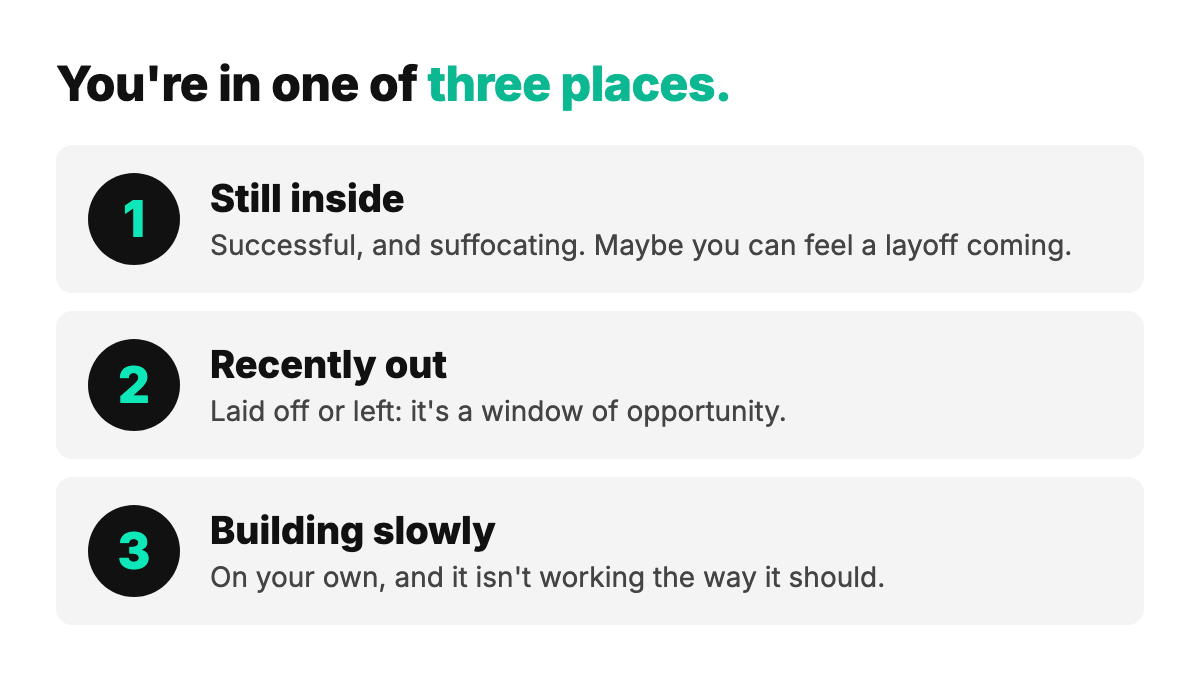
Most of what follows is weighted toward the first, because that's where most people start. But the work is the same for all three.
What "Graduation" Actually Means
Nobody stays in college for 20 years. If somebody did, you'd assume something had gone badly wrong.
But stay 20 years in a corporate career, and we call it normal. It just keeps going. No ceremony, no date. Nobody hands you a piece of paper that says you're finished.
You earn a graduation. And you take what you earned with you. Your judgment, your pattern recognition, and your relationships are raw material. Almost none of it has ever been pointed at something with your name on it.
Graduating doesn't mean quitting tomorrow. For many people, it starts with the job still in place. That can mean keeping the paycheck for 6 to 18 months.
You make your employer your investor. An investor bankrolls a founder while the business gets built. Your job can do the same thing. It covers the mortgage and the tuition while you build. You give it your competence, and you stop giving it your soul.
Your corporate job becomes secondary.
Your founder path becomes primary.
In practice, you’ll run two parallel tracks:
Ramp down Corporate: Cut the hours, keep the paycheck
Ramp up Founder: Build the identity, IP, and product
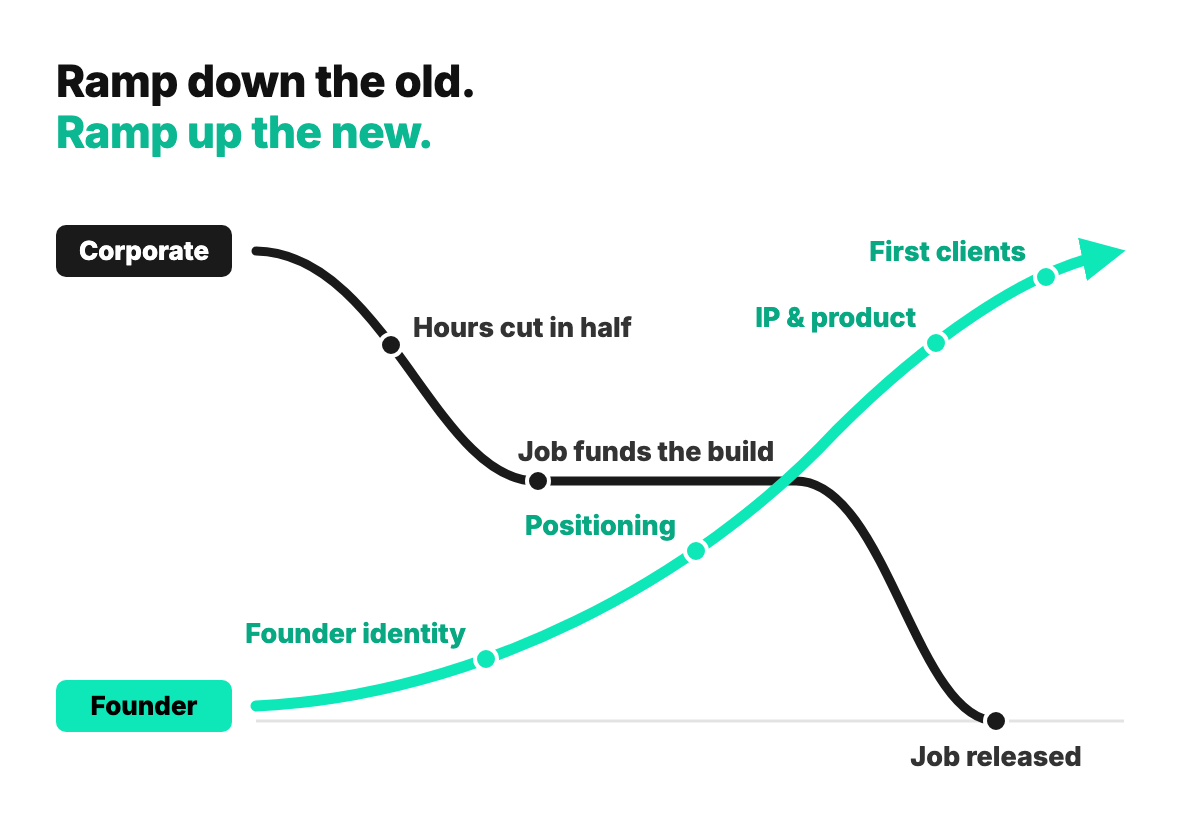
One of my clients is a VP at a large technology company. He quietly compressed his job down to 10 hours a week. He's survived every round of layoffs, and his paycheck is funding his business, his wife, and 4 kids.
If that sounds impossible from where you're sitting, suspend your disbelief for now. Compressing a senior role sounds reckless until you have a system for doing it the right way. Keep the skepticism. Just don't let it make the decision for you.
The job stays, and you feel at peace and in control. That's part of graduating too. When the timing is right, the job gets released, and you make that call with your family.
If you're recently out, the same ramp runs on savings instead of a salary, which makes the order even more important. If you're building slowly, it usually means going back and laying the foundation you skipped (more below).
A university experience sets your graduation date.
Here, that’s on you.
Two Forces at Play
Two forces make someone ready to graduate: Push and Pull.
Push is what's driving you out. People have said these to me, word for word:
"Work gave me a mini stroke."
"My marriage is about to break."
"I feel like I'm wasting my life."
Pull is what's drawing you toward something of your own:
"I've outgrown this environment."
"All my work here is done."
"I'm sitting on gold."
You need both. Push without Pull sends you to the first logical exit you can find. Pull without Push stays a daydream.
If this is right for you, you already feel some combination of the two.
What You Actually Want
Underneath Push and Pull, people want the same three things.
Ownership: assets you built, with your name on them
Freedom: over your time, money, and energy
Impact: work that helps people you deeply care about
You want all three. Nothing less.
But today's popular “corporate exit” moves don’t allow all three.
The Moves That Don't Work
When the pressure finally gets real, most people reach for one of three familiar moves. Each one feels responsible. Measure them against ownership, freedom, and impact, and they come up short.
Shinier Cage. A new company, a new role, a promotion. Better lighting, same cage. It feels good for about 30 days, then the old feeling comes back, because the employer was never the problem.
Spreadsheet Exit. A franchise, real estate, a boring business. It pencils out, and it uses none of who you are. Cash-flow plays have their time and place. They just can't be the primary move beyond corporate for someone who wants ownership, freedom, and impact. Nobody with 20 years of hard-won judgment lies awake wishing they owned a car wash.
Rented Expertise. Consulting, coaching, a fractional role, an agency. It's corporate replication, and a failure of imagination. You print business cards that say Fractional CMO, and so do 10,000 other people, most of them before lunch. When a prospect compares you, the only thing left to compare is the rate.
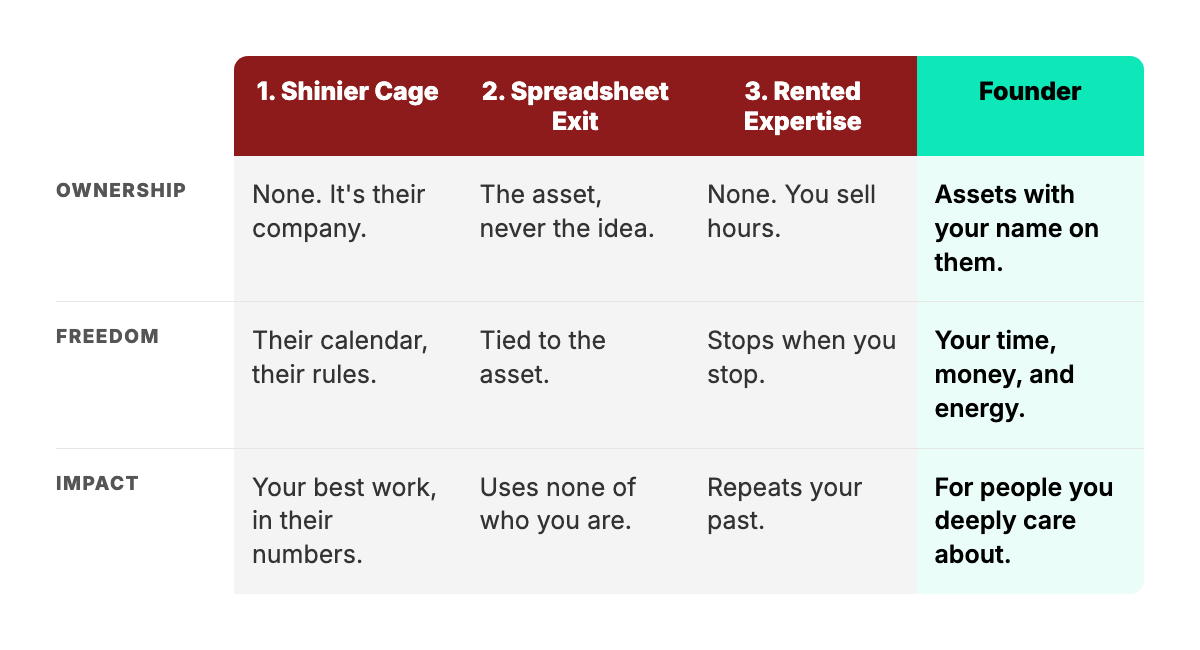
Each one gives you a piece of what you want, at best.
Only the last column gives you all three.
Let’s dive into that.
Founder, Without the Garage
When most people hear "founder," they picture Steve Jobs in a garage, a seed round, a Y Combinator demo day, and a pitch deck. In business school, we studied those founders as case studies. I never imagined I could be one.
But the world shifted.
Today, you don't need venture capital, a technical co-founder, or a pile of money. You need the drive. The hoodie is optional.
For a corporate lifer like me, that was revolutionary news. I had zero entrepreneurial experience. It opened up a whole new world of possibilities
The tools changed, too. With today's AI, one person with real intuition and vision can build what used to need a whole team.
The garage story also gets the age wrong. 20 or more years of experience is now an advantage, and the research backs it up.
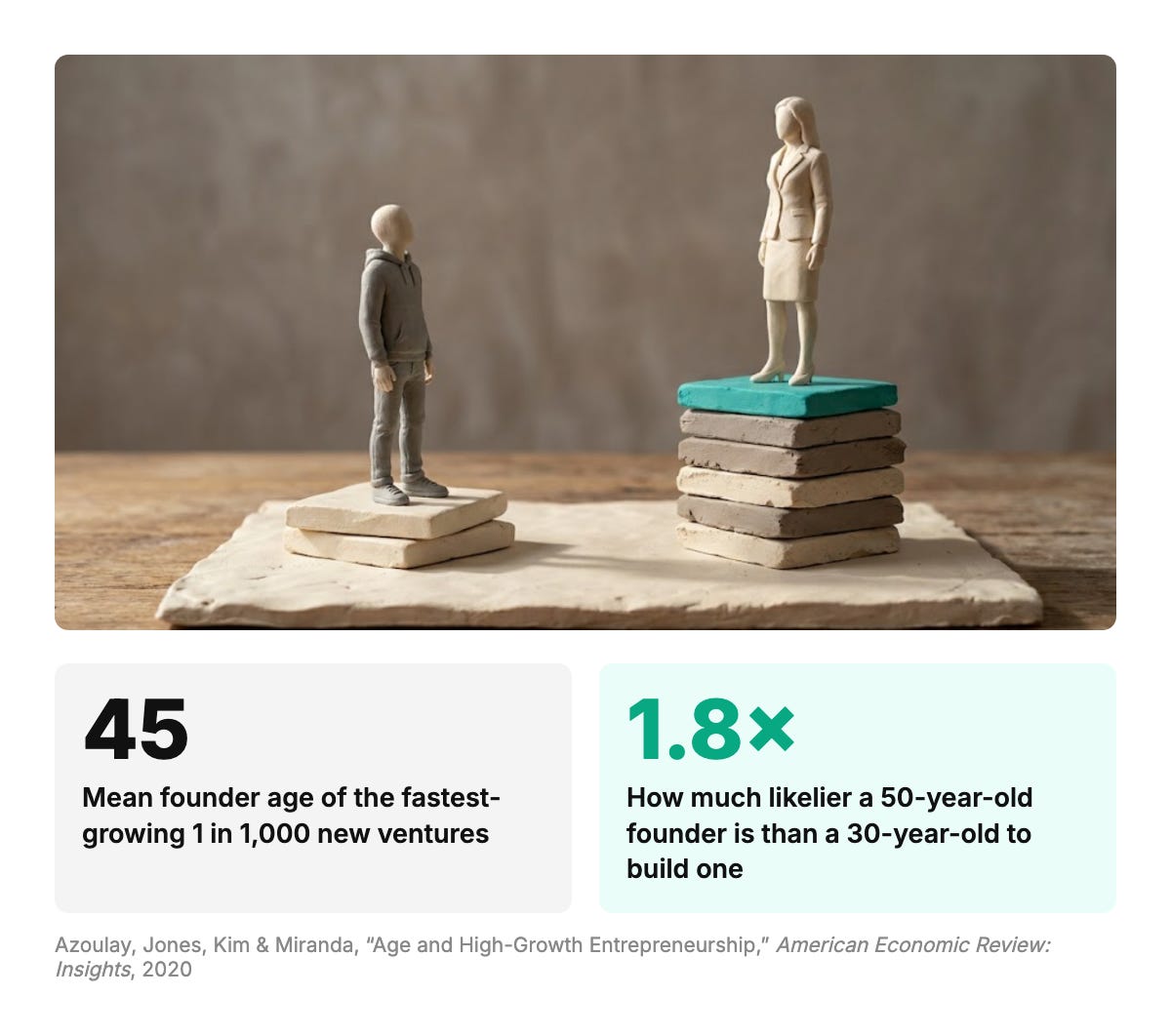
A founder turns years of judgment into an idea they own, turns that idea into products people pay for, and becomes known for an outcome.
John is a VP of marketing I work with. He didn't go fractional. He built a category called Retention Directive™. His category, his IP, his product, his people. Nobody else is in it, so nobody competes with him on price.
A consultant rents time.
A founder owns an idea.
Think about how each one lands on the person across the table.
"Consultant" sounds like one of thousands.
Founder of ______ says you've put deep thinking into an outcome they're meant to have in their life.
Just look at the difference:
Founder of Corporate Graduation
Founder of Retention Directive
Founder of Career Free Agency
Founder of ______
Imagine what that does for you, and for everyone who comes into contact with you.
It's a completely different psychology.
But the title is the easy part.
Underneath it is work that has to happen first, and it's the step almost everyone gets wrong.
The Founder Comes Before the Business
Picture this person:
60-hour corporate weeks
Exhausted, operating from need
Generic credentials & LinkedIn profile
No idea what makes them different
Now picture this person:
Corporate hours compressed
Healthy, and home life is good
Dedicated best energy to building
Surrounded by a tribe doing the same
Now, go ask both of them to build a unique and valuable business.
Which one is likely to succeed as a founder?
The answer has nothing to do with the business. It comes down to who's driving it.
Think about F1. You could hand someone the fastest car in the world at Monaco. If the driver isn't ready, they crash.

Your business works the same way.
The business is the car.
You're the driver.
If you're not yet capable of running it, it crashes. A corporate VP, however competent, has no business driving an F1 car on day one.
Almost all the advice out there starts with the car anyway: find your niche, build your offer, burn the boats.
This is horrible advice.
For somebody 20 years into corporate, that's the most reliable way to fail. It's how I failed 3 times.
Over the last decade, I’ve learned that the corporate-to-founder transformation has a sequence.
And it’s non-negotiable:
Space. Compress the job, make room.
Self. Rebuild who corporate made you.
System. Build the IP, product, and business.
In that order, every time.
Be a Beginner Again
And let’s be clear: even though there’s a clear framework for Corporate Graduation, this isn’t all sunshine and rainbows.
There's a stretch in the middle that won't look like progress. You'll go quiet for a while. You'll be a beginner again after decades of being the most capable person in the room.
Seth Godin calls it the dip.
The dip isn't a detour. It's the way.
It's also where this gets fun.
The last time you were a real beginner, it was exciting. Full of growth. That growth is where the founder and the business get built.
Get curious about it. Most people your age stopped growing a long time ago. You're about to start again.
From Corporate Past to Founder Future
Go back to the person at the top of this page.
It's a Monday, 18 months from now. Maybe the job is still there, running in half the hours, paying for the build, and it no longer decides who they are. Maybe the job has been released.
Either way, there's an idea with that person’s name on it, a first product, and people paying for it. A whole new life is unfolding.
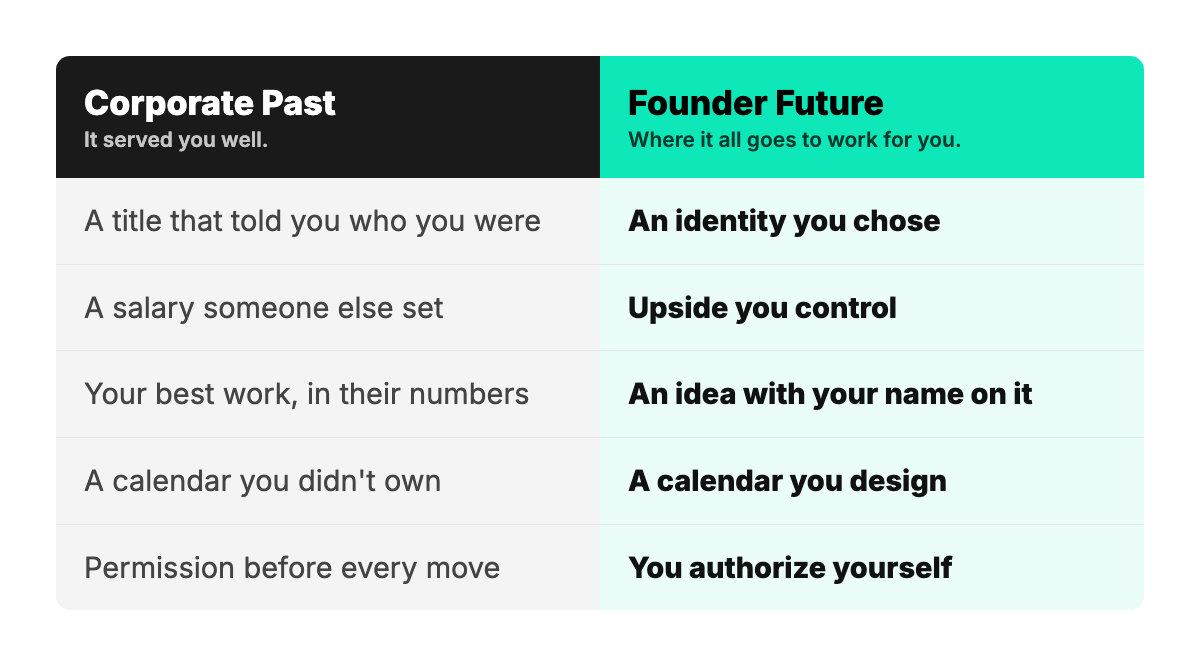
Nothing got torched. The family came along. The 20 years finally went somewhere.
The measure I trust most is simple.
Everything in your life changes when this is true:
You wake up at 5AM on a Monday, and you can't wait to get to work.
Everything and everyone in your world gets better for it.
That’s return on life.
That's Corporate Graduation.
The move from your Corporate Past to your Founder Future.
Nobody's going to hand you this diploma.
You have to earn it.
PS - Every term in this essay is defined in one place: What Is Corporate Graduation? If you want to go deeper, find all resources at corporategraduation.com.
PPS - If you need to move fast, go here.
I said goodbye to corporate.
20 years as a Director in financial regulation. +4 in professional services
The jury is still out on whether I blew up my life. I believe I blew it open.